Cross Your Eyes
Fuse colorful stereo pairs and spot what floats closest.
Choose a challenge
Optical illusion games, hidden 3D, crossed-view stereo puzzles, and visual perception challenges.
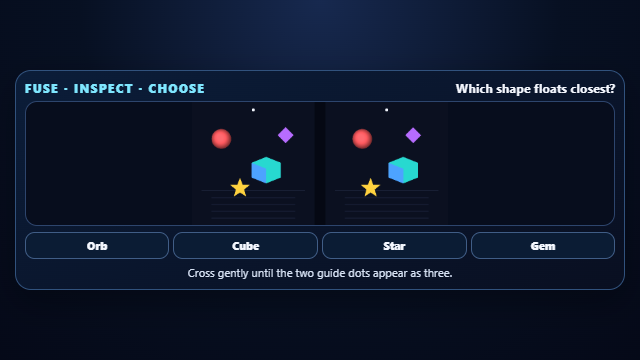
Choose the viewing method first: Cross Your Eyes uses side-by-side crossed-view stereo pairs, while Hidden 3D uses single-image parallel-view stereograms with its own guide dots and reveal controls. Both formats depend on screen size, viewing distance, and how the image is scaled, so open a game at full size and avoid browser zoom before judging an effect. Crossed-view pairs ask your eyes to converge in front of the screen; parallel-view stereograms ask them to look through it. If either method feels uncomfortable, stop and take a break: a headache is not a sign that you are using the game incorrectly.
Eye Tricks contains two deliberate stereogram experiences. Cross Your Eyes uses side-by-side cross-view pairs, while Hidden 3D uses single-image parallel-view stereograms with guide dots and reveal controls. The viewing method matters more than the theme: try the method named on each card, keep the screen at a comfortable distance, and take a break if your eyes tire. Both games offer guidance and a way to skip a puzzle; neither is a vision test or a medical assessment. Larger screens are easier for many people, but the pages state the controls and limits that apply. Cross-view and parallel-view are not interchangeable: a stereogram made for one method can look flat when viewed with the other. Start with the method named on the card, use the guide dots or viewing coach, and use Reveal or Skip when you want to move on. The games describe visual perception puzzles, not eye-health claims. If a puzzle still refuses to resolve, that is not a failure: switch to the other game, read the viewing guidance again, or take a longer break before retrying.